

Where should you start?
When I speak to businesses, most already have an idea where to start — improve the content, fix the social, hire an AI marketer for one function. I always ask why they want to start there, and what they are trying to solve, and usually the answer is “we have not been consistent with content” or “the lead quality from Google Ads has dropped”.
There is no right or wrong place to start — pick somewhere and improve. But when I start with a business from scratch, I get the foundation right first, because that is what makes everything later easier.
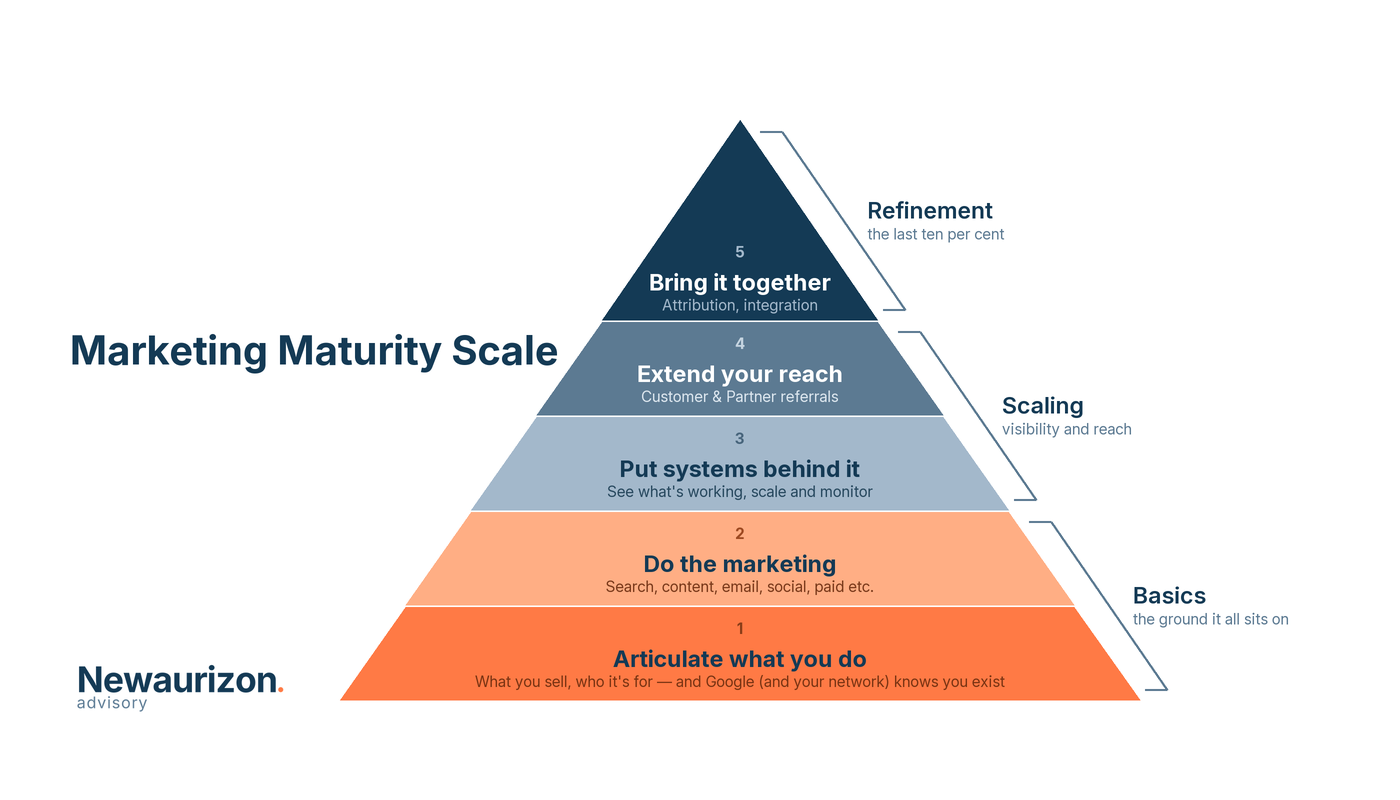
What are the five levels of marketing maturity?
That foundation has five levels, and it works as a check-up rather than a course: it will not teach you each level, only help you spot which ones you have and which are missing.
**Level 1 — Articulate what you do.** Someone lands on your website and can tell, in a few seconds, what you sell and who it is for. Behind the scenes, the basic tools are on so you can see who is finding you. Your brand belongs here too: your name, your look, the words you use to describe yourself.
**Level 2 — Do the marketing.** You are getting in front of people who might buy, through search, articles, email, social media and ads, and it counts even if you are doing all of it yourself.
**Level 3 — Put systems behind it.** Tools that send the emails, track who enquired and record what happened. Most people think the point is saving time, but the bigger point is the record, so you can see what is working.
**Level 4 — Extend your reach.** Customers and partners who send people your way — helpful, but not a substitute for doing the work yourself.
**Level 5 — Bring it together.** Working out which parts of your marketing deserve the credit for a sale, and running everything as one joined-up plan. Real work, and the last ten per cent of the result.
One thing this assumes: you already have something someone is willing to pay for.
Do you have to do them in order?
Nobody starts at level 1 and works up. Real businesses turn up with gaps everywhere: a consultancy with fifteen years of word of mouth and a website untouched since 2019, or a founder posting on LinkedIn twice a week with no Google Business Profile. None of that is wrong, and you are not penalised for the order you did things in.
So the scale makes one claim about order, and only one. **The levels near the bottom make everything above them work better.** Word of mouth works without systems, but you cannot grow it without them. You can pay someone to work out which ad won a sale, but they will just be rebuilding what you could have written down as you went.
That is why the pyramid is wide at the bottom: not because you do those things first, but because more of your result rests on them. It is also why nobody finishes — the bottom is upkeep, and last year’s description of your business often describes a business that no longer exists.
The two ways people get this wrong
There are two opposite ways to get marketing wrong, and I have made both.
The first happens at the top of the scale. I sit down with an exec and start explaining attribution, the work of figuring out which part of your marketing won the customer — the ad they clicked, the March email, or the article they found months before any of it. Somewhere in the second minute I catch their face, and it tells me they neither follow it nor care.
They are not being rude, just clear about what they hired marketing to do — bring in enquiries, back the sales team, grow the business — and how it happens is a detail they are right not to dwell on.
So why do we keep doing it? Because the work is hard, and hard work needs defending. Attribution and integration swallow months, and once something has taken months you have to defend it, so the method becomes the conversation instead of the result.
The second mistake is the opposite, and I hear it more often from owners. “We’re doing content.” “We’ve got social running.” “We’re spending on ads.” The belief underneath it is that marketing **is** those activities, and switching them on is the whole job. But an activity with nothing under it cannot tell you anything: the website does not say plainly what you sell, so visitors do not become enquiries, and nothing records where they came from, so you cannot repeat a good month.
This one costs more, because it looks like progress: something goes out every week, money leaves the account, the dashboard has numbers on it, so nobody asks the harder question for a year.
What the two have in common is a swap: one mistakes the measuring for the result, the other mistakes the activity for it. Both answer **how** when the business asked **why**. And the why has not changed in a hundred years: did more of the right people find you, and did more of them buy?
Level 1 — Articulate what you do
**What it is.** A stranger lands on your website and can tell what you sell, who it is for, and what problem you fix. Behind that sit the basic tools: Search Console and Analytics tell you how people arrive, a Google Business Profile puts you on Maps and in local results, and enquiries need to land somewhere a human actually opens.
**How to tell it is missing.** You redesigned the website and enquiries did not change, or people still ask what you do after reading the home page.
**What it costs you.** Every dollar you spend higher up pushes more people towards a message that is not landing, and paid ads at a vague page just buy the same confusion faster.
The gap is wider than most people assume. When the Australian Bureau of Statistics last measured it, in 2016–17, only 51.1% of Australian businesses had any web presence at all. That is old and has improved since, but the pattern has not: the smaller the business, the likelier the basics are missing.
**The cheapest first step.** Write one sentence saying what problem you solve and who for, put it at the top of your home page, and check it against the words a customer would type to find you.
Level 2 — Do the marketing
**What it is.** Getting in front of buyers, again and again, through search, articles, email, social media, events and ads. Talking to the customers you already have starts here too, and so does using your brand, because every post and page looking and sounding like the same business is how people come to recognise you.
Ads belong at this level, not higher: paying for enquiries is the easiest way to get seen, not the most advanced, and most businesses cannot wait for search. The mistake is paying before level 1, which just sends more people to a message that is not landing.
**How to tell it is missing.** Marketing happens only when somebody remembers, so there are gaps of months, and the last three things you published went out in the same week.
**How to tell you are stuck here.** You can list your channels but not your results.
**What it costs you.** Between word-of-mouth referrals you are invisible, and growth arrives in lumps you cannot predict.
**The cheapest first step.** Pick one channel and a rhythm you can keep in a busy month, not just a quiet one: one post a fortnight for a year beats four and then nothing.
Search is changing here too — around four in ten companies now work to get named inside AI answers. We wrote about how tools like ChatGPT and Google’s AI summaries pick which business to name, and separately about what that looks like for a Melbourne business.
Level 3 — Put systems behind it
**What it is.** The tools and habits that keep marketing running and record what happened. A CRM is a shared list of everyone who has enquired and what you said back; automation means the follow-up goes out without you remembering.
The usual pitch is that this saves time, but the bigger gain is that you can finally see what is working, because the system keeps the record.
**How to tell it is missing.** You cannot say where last month’s enquiries came from, or somebody asks which channel works best and you answer with a feeling rather than a number.
This is not only a small-business problem: in a 2026 survey of senior marketers, not one marketing technology skill scored above 5 out of 7, and big companies own the tools but still cannot read them.
**What it costs you.** You cannot repeat what worked, because you do not know what it was, and every month starts from nothing.
**The cheapest first step.** Make sure every enquiry lands somewhere you can count, with a note of where it came from, and a spreadsheet is fine, because the tool matters far less than the habit.
Level 4 — Extend your reach
**What it is.** Customers and partners who send people your way, without you being in the room.
Be clear-eyed about it: other people helping is a genuine multiplier, but not the same as other people selling for you, and referrals need looking after like anything else.
This is the level most often owned and least often worked: plenty of businesses run almost entirely on word of mouth and have never once asked for a referral on purpose. Bigger companies show the same blind spot in their budgets: new-customer spend runs about 26% higher than the spend on keeping existing ones, so the people most likely to recommend you get the least attention.
**How to tell it is missing.** Every new customer traces back to you: your calls, your network, your calendar.
**What it costs you.** Growth is capped by your own hours, and that cap arrives sooner than you expect.
**The cheapest first step.** Ask three happy customers who else should know about your work, then ask whether they would make the introduction, because at this stage that is the entire plan.
Level 5 — Bring it together, the last ten per cent
**What it is.** Working out how much credit each step deserves when somebody saw five things before buying, running your channels as one plan not five, and using maths to work out what each is worth.
This is real work and it is hard, which is exactly why the conference talks are about it. The argument is not that it is worthless, but that it is ten per cent of the result soaking up most of the attention, and the ones reaching for it are often reaching past something cheaper.
**How to tell you are here too early.** You are arguing about how to measure your marketing while your home page still does not say what you sell — paying at level 5 for what level 3 gives you free.
Which is the whole point of the scale, in one line: **you do not need a clever model to know that doing more of A gets you more of B. You need the first three levels.**
**When it genuinely is your next move.** When levels 1 to 4 hold up on their own, and the honest question has become which combination of things produced a particular sale. Most businesses asking it have not earned it yet, though some have.
How do you know where you are?
Five questions, one per level — answer them honestly rather than hopefully.
1. Can a stranger read your home page and tell what you sell and who it is for? 2. Did you publish or send something to potential buyers last month, and the month before? 3. Can you say where last month’s enquiries came from, with a number rather than a feeling? 4. Did anyone recommend you last quarter without you asking them to? 5. Can you say which combination of things produced a particular sale?
You are not looking for a score but for the shape — most people can answer 4 but not 1, or 2 but not 3.
The useful question is not “what level am I on”. It is **which missing level is holding back the ones I already have.** A business with strong word of mouth and a vague website is not failing at word of mouth; it just gets a fraction of what those referrals are worth, because half the people who look it up cannot tell what it does.
If you would rather not do that alone, a fractional marketing lead does this kind of diagnosis before touching anything.
When this does not apply to you
Three cases where this does not apply, common enough to say plainly:
**You do not have something people pay for yet.** If the product or the audience is still unproven, marketing will make that clearer, not fix it.
**You cannot look after the customers you already have.** More visibility does not help a business that is full, so fix delivery first.
**You genuinely have levels 1 to 4 running.** Then level 5 is your next move, and you can ignore the tone of this article: joining everything up is the right problem for a business that has earned it.
Frequently asked questions
What is a marketing maturity model?
A way of describing what a business builds as its marketing grows up, so you can see which parts you have and which are missing. This one has five levels: articulate what you do, do the marketing, put systems behind it, extend your reach, and bring it together.
Why do marketers spend so much time on measurement?
Because the work is genuinely hard, and hard work needs justifying. Working out which part of your marketing won a customer takes months, and once something has taken months it has to be defended, so the method becomes the conversation. The person who asked usually wanted one thing: more of the right people finding the business, and buying.
Where does branding fit?
Branding shows up in two places. You decide it at level 1, because your name, your look and the words you use to describe yourself are part of saying what you do and who it is for, and you use it at level 2, where everything you publish should look and sound like it came from the same business.
Where do paid ads fit?
Paid ads sit at level 2. Paying for enquiries is the easiest way to get in front of buyers, not the most advanced, and the mistake is not using ads early but using them before level 1, when they simply send more people to a message that is not landing.
How long does it take to move up a level?
It varies, and not evenly. Level 1 is usually a few afternoons, because most of it is writing plainly and switching on tools that already exist; level 3 takes weeks; and level 5 takes months, which is another reason to be sure you need it.